

Creating a compelling resume as an aspiring Certified Nursing Assistant (CNA) can be challenging, especially when you lack extensive work experience. For recent graduates or entry-level healthcare professionals, this task can feel like a significant barrier to landing interviews. With hospitals and nursing homes relying heavily on applicant tracking systems (ATS) to filter candidates, it’s essential to effectively highlight your transferable skills, relevant certifications, and genuine compassion for patient care to stand out.
This comprehensive resource is tailored for healthcare job seekers in the United States, from newly certified CNAs to those transitioning from caregiving or volunteer roles. Drawing on proven resume writing strategies, it explains how candidates can create an effective entry-level CNA resume that emphasizes qualifications, aligns with employer expectations, and passes ATS scanning systems to secure interviews and job offers in competitive healthcare settings.
Understanding the CNA Role and Employer Expectations
A Certified Nursing Assistant plays a vital role in direct patient care under the supervision of registered nurses and licensed practical nurses. CNAs assist patients with daily living activities such as bathing, grooming, feeding, mobility support, and vital sign monitoring. In 2025, the demand for CNAs in the United States remains strong, with the Bureau of Labor Statistics projecting steady job growth driven by the aging population and expanding long-term care facilities.
Healthcare employers expect even entry-level CNAs to demonstrate reliability, empathy, and the ability to work efficiently in fast-paced environments. While previous experience is beneficial, hiring managers often prioritize commitment to patient care, communication skills, and basic clinical competencies. Therefore, a well-structured resume that emphasizes these core traits can significantly enhance hiring prospects, especially when combined with relevant certifications such as Basic Life Support (BLS), CPR, or First Aid.
Medical facilities across the United States—ranging from nursing homes to rehabilitation centers—seek CNAs who can adapt quickly, comply with HIPAA regulations, and maintain accurate patient documentation. By aligning resume content with employer expectations, candidates can position themselves as dependable professionals ready to contribute to patient safety and comfort from day one.
Essential Sections of an Entry-Level CNA Resume
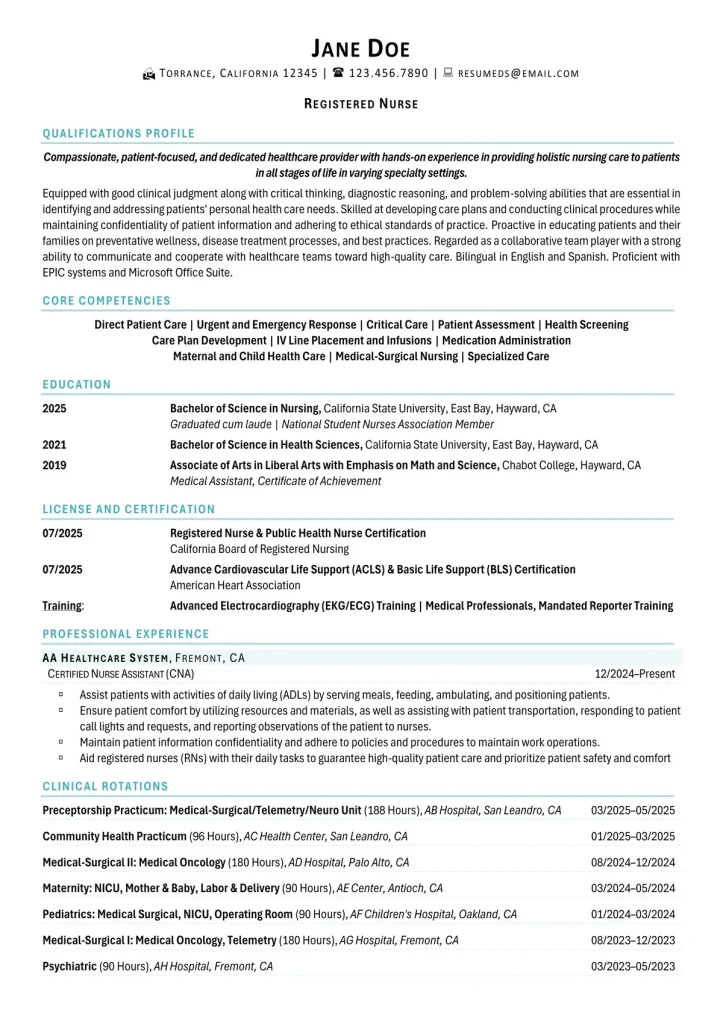
Every effective CNA resume should follow a consistent format that highlights education, certifications, and clinical skills. Even without extensive experience, a compelling entry-level CNA resume can convey readiness to perform essential tasks through a clear and industry-standard layout. Each section should be purposeful and tailored for healthcare recruiters.
- Contact Information: Include full name, city and state, phone number, professional email address, and LinkedIn profile (if applicable). Ensure this information is consistent across all application materials.
- Professional Summary: A concise 3–4 line overview highlighting key strengths such as compassionate care, attention to detail, and commitment to patient safety. Avoid objective statements that merely restate job titles.
- Certifications: Feature Certified Nursing Assistant credentials first, noting the issuing state and active status. Add supporting certifications such as CPR, BLS, and First Aid Training.
- Education: List certificates or diplomas in chronological order, including training schools and graduation dates.
- Clinical Experience or Training: Showcase hands-on experience gained during CNA programs, internships, or volunteer work. Bullet points should emphasize measurable contributions, for example, “Assisted 15+ patients daily in maintaining personal hygiene and comfort.”
- Skills Section: Group relevant abilities under categories like “Patient Care,” “Communication,” and “Technical Proficiency.” This clarity allows ATS systems to detect matching keywords.
- Work or Volunteer Experience: If lacking professional exposure, clinical rotations, community service, or caregiving roles can be included to demonstrate transferable competencies.
Each section of the resume should be customized to the job posting. Keyword optimization is crucial: terms such as “long-term care,” “vital sign monitoring,” “infection control,” and “patient documentation” commonly appear in CNA job descriptions and should appear naturally throughout the document.
Here’s a CNA resume example that you may use to familiarize yourself with the essential parts:
Formatting and Design Tips for ATS Optimization
The average recruiter spends less than 10 seconds scanning a resume before deciding whether to proceed with a candidate. For aspiring CNAs, effective formatting can be the difference between being shortlisted and overlooked. Your entry-level CNA resume must be visually clean, easy to navigate, and compatible with applicant tracking systems commonly used in hospitals and senior care facilities.
- Choose a simple layout: Use a single-column structure with clearly labeled headings such as “Education,” “Certifications,” and “Professional Experience.” Avoid graphics, icons, and tables that can cause parsing errors in ATS systems.
- Stick to standard fonts: Calibri, Arial, and Times New Roman are professional and ATS-friendly. Maintain a font size between 10 and 12 points for readability.
- Use consistent formatting: Bold section headers, align text left, and use bullet points for job duties and accomplishments. Maintain equal spacing throughout the resume.
- Include measurable results: Instead of generic descriptions, use quantifiable statements such as “Provided direct care to 20 patients per shift” or “Reduced fall incidents through attentive monitoring.”
- Keep it to one page: For an entry-level CNA resume, focus on concise, relevant information. Additional pages can dilute impact and reduce readability.
File formatting also matters. Since most employers use online submission portals, the entry-level CNA resume should be saved as a PDF or Word document (.docx). PDFs preserve formatting, while Word files sometimes integrate better with certain ATS applications. Reviewing submission instructions is critical to ensure compatibility.
Key Skills to Showcase on an Entry-Level CNA Resume
Employers rely on CNAs to deliver consistent, compassionate, and technically sound care. Therefore, healthcare recruiters prioritize both soft and hard skills. A balanced skill set reinforces an applicant’s ability to handle patient care duties while cooperating with multidisciplinary healthcare teams.
| Soft Skills | Technical Skills |
|---|---|
| Empathy and Compassion | Vital Signs Monitoring |
| Communication and Teamwork | Infection Control Practices |
| Time Management | Electronic Medical Record (EMR) Documentation |
| Adaptability | Patient Mobility and Transfer Assistance |
| Attention to Detail | Basic Life Support (BLS) |
Every listed skill should be supported by context in the entry-level CNA resume. For instance, “Demonstrated empathy and communication skills by assisting post-operative patients with mobility exercises” is more impactful than a simple mention of “empathy.” ATS algorithms also reward skill-based keywords when they appear naturally in experience or clinical training sections.
Writing a Strong CNA Resume Summary
An effective entry-level CNA resume summary should immediately convey value to the employer. Instead of describing general ambitions, it must focus on concrete strengths and specializations relevant to the role. The summary replaces old-fashioned objectives and guides recruiters toward the candidate’s core qualifications within the first few lines.
Below is an example structure for an entry-level CNA summary:
- Opening line: Mention CNA certification and primary career goal.
- Key competencies: Highlight strengths such as patient care, clinical assistance, and accuracy in documentation.
- Soft skill integration: Include qualities like collaboration and compassion to reinforce a patient-centered approach.
Example: “Certified Nursing Assistant with strong clinical training and proven dedication to patient comfort. Skilled in assisting daily living activities, monitoring vital signs, and maintaining accurate records in compliance with hospital protocols. Known for compassionate care, teamwork, and commitment to supporting multidisciplinary staff in delivering high-quality medical services.”
A summary like this emphasizes both competence and personality—two critical factors hiring managers value in healthcare roles. It also integrates ATS-recognized keywords while maintaining natural readability.

Highlighting Education, Certifications, and Training
Education and certifications are among the most influential factors in CNA hiring. Because entry-level professionals often have limited direct employment history, the training and credential section can serve as a powerful differentiator. Each listing should include the issuing institution, completion date, and active certification numbers if applicable.
| Credential | Description |
|---|---|
| Certified Nursing Assistant (CNA) | Issued by state nursing boards after completion of approved training and competency evaluation. |
| Basic Life Support (BLS) Certification | Required by most hospitals; focuses on CPR, adult-child resuscitation, and AED usage. |
| First Aid Certification | Covers immediate response for injuries, burns, or cardiac emergencies. |
| HIPAA Compliance Training | Demonstrates understanding of patient confidentiality and data protection laws. |
Including continuing education or volunteer-based health training reinforces commitment to professional growth. If the CNA is newly certified, listing details such as “125-hour state-approved CNA training program” gives employers tangible proof of competency.
Strategies to Demonstrate Experience Without Employment History
Entry-level CNAs often worry that limited work experience might weaken their resumes. However, employers understand that every CNA begins somewhere. What matters most is the ability to demonstrate readiness through relevant training, volunteer involvement, and practical exposure during clinical rotations.
- Focus on clinical achievements: Detail measurable outcomes, such as patient satisfaction improvements or infection control compliance.
- Leverage volunteer activities: Include caregiving or community health work that illustrates compassion and dependability.
- Highlight transferable skills: If previously employed in hospitality, childcare, or customer service, emphasize teamwork, empathy, and multitasking capabilities.
- Use active verbs: Terms like “assisted,” “monitored,” “supported,” and “maintained” make each bullet point more dynamic and impactful.
Recruiters value dedication and teachability even more than experience in many entry-level CNA roles. Consequently, integrating keywords such as “patient-centered care,” “resident assistance,” and “quality improvement” conveys alignment with healthcare organizational values.
Common Mistakes to Avoid When Writing an Entry-Level CNA Resume
- Overloading with irrelevant content: Including unrelated part-time work without linking transferable skills can dilute focus.
- Ignoring ATS keyword relevance: Entry-level CNA resume without industry-specific terms risk rejection before human review.
- Using generic objectives: Phrases like “Seeking a position to grow my career” fail to highlight clinical value.
- Inconsistent formatting: Misaligned dates, font variations, or long paragraphs hinder readability.
- Neglecting accomplishments: Listing only job duties rather than measurable achievements weakens credibility.
Attention to structure and accuracy can convey professionalism even before the interview stage. It reinforces reliability—an essential quality in healthcare positions that directly impact patient wellbeing.
Salary Outlook and Career Growth for CNAs
According to data from the U.S. Bureau of Labor Statistics, the median annual wage for Certified Nursing Assistants in the United States currently exceeds $38,000, with higher pay in hospitals and government facilities. CNAs who pursue additional education often advance into Licensed Practical Nurse (LPN) or Registered Nurse (RN) roles, earning significantly higher salaries.
Regions such as California, New York, and Massachusetts continue to offer some of the most competitive hourly rates. Additionally, specialization in geriatric care or hospital-based CNAs provides stable employment and opportunities to work closely with diverse healthcare teams across acute, subacute, and rehabilitative settings.
For entry-level professionals, maintaining an updated resume is one of the strongest career habits. By regularly adding new certifications, job seekers ensure alignment with future healthcare regulations and demonstrate a long-term commitment to patient advocacy and continuous learning.

Achieve Healthcare Career Success with a Strong CNA Resume
A strong résumé can open doors to rewarding opportunities in hospitals, long-term care facilities, and rehabilitation centers. For those just starting out, emphasizing compassion, clinical training, and reliability remains the foundation of an excellent professional profile. Many healthcare professionals launch successful careers through professionally crafted documents developed with guidance from medical resume writing services that tailor content to the needs of U.S. healthcare employers.
Frequently Asked Questions
What should be the ideal length for an entry-level CNA resume?
An entry-level CNA resume should fit on one page, focusing on training, certifications, and clinical skills. Keeping it concise ensures readability and matches recruiter expectations for healthcare support roles.
How can CNAs list unpaid clinical experience?
Clinical rotations completed as part of CNA training should be listed under “Clinical Experience” or “Training.” Each entry can include the healthcare facility, time frame, and key patient care tasks performed.
Which certifications increase hiring potential for CNAs?
In addition to CNA licensure, employers value CPR, BLS, and HIPAA compliance training. These certifications confirm immediate job readiness and safety awareness in healthcare environments.
Should soft skills be included in a CNA resume?
Yes. Soft skills like empathy, teamwork, and communication are vital in patient care. Employers prioritize CNAs who combine technical competence with interpersonal strengths that foster trust with patients.
How often should a CNA update their resume?
CNAs should update resumes annually or after completing new certifications or training programs. Refreshing details ensures applicants remain competitive in the evolving healthcare sector.